
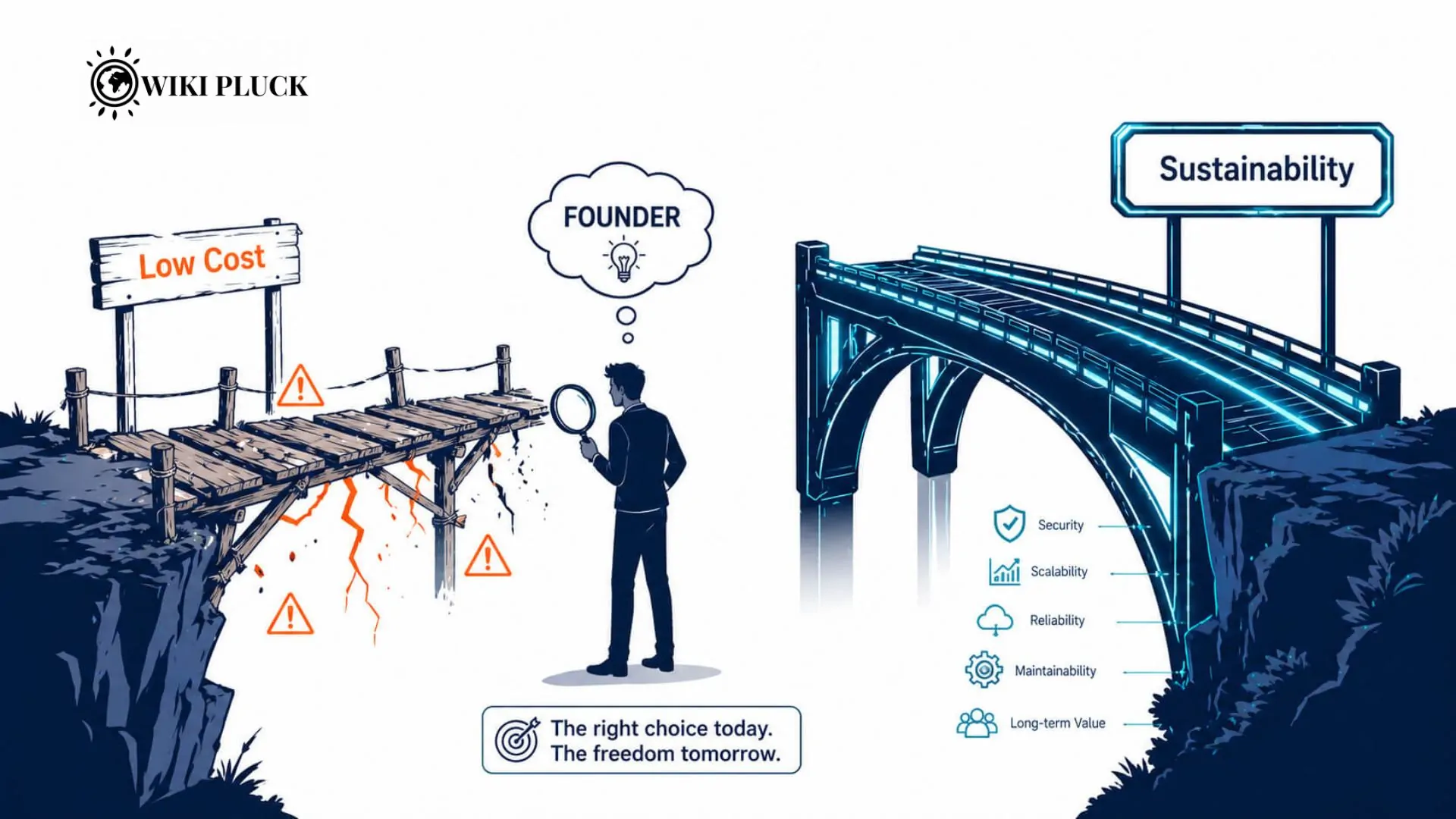
Nearly all tech entrepreneurs grapple with the same question: you’ve imagined a breakthrough Software-as-a-Service (SaaS) solution and are now looking for bids, and you’ve received two bids for $150,000 and one “outlier” bid from a budget agency for $20,000. The temptation to save $130,000 is hard to resist. However, sticker price can sometimes be very misleading when it comes to the cost of software engineering.
To understand the true cost of developing a SaaS solution you need to consider it like an iceberg – what you see (above water) is only 10%-20% of the total size of the iceberg (under water). The remaining 85%-90% of costs are the things that will sink your business before you hit profitability. To create a viable business you need to look beyond just the quote and understand what your Total Cost of Ownership (TCO) is going to be.
To help you determine these types of costs associated with an “affordable” development, listed below are the seven hidden cost factors that budget agencies will not tell you about.
The “Maintenance Tax”: Life After Launch
One of the most prevalent myths in technology is that when a program’s code is finished developing, financial resources do not get used anymore. The reality is that a program is always “evolving,” and thus requires continual maintenance; it doesn’t stop evolving when it is done developing due to browser releases, operating system releases and 3rd party API protocol modifications.
According to IEEE industry statistics, the yearly cost of maintaining SaaS (Software as a Service) typically ranges from 15% up to 20% of the original amount paid to develop the SaaS.
- The Math: If you spend $50,000 developing a basic SaaS system, then you will incur a minimum cost each subsequent year of around $10,000 just to maintain and keep the system operating.
- Risk of high maintenance: If the developer used lower priced/lower quality libraries in order to reduce costs, then you will incur higher long term maintenance costs due to having to create more frequent updates or fixes to achieve compatibility over time.
Also Read: People Analytics: Turning HR Data into Strategic Business Decision
The Technical Debt “Interest Rate”
Whenever a developer provides you an offer that appears unrealistic (too good to be true), it is likely that they are taking money from your future in order to provide their current price – this is what is called Technical Debt.
Budget developers who are trying to get their pricing to a low point typically do not document their code, utilize “spaghetti code”, or neglect modular architecture. While it may work for a while, the system will eventually become inflexible when you’re trying to scale.
Eventually, you will find yourself at the “Sustainability Gap” where 90% of your team’s time is spent fixing the bugs in existing products versus building new value. As a result, many founders who take the budget route will ultimately be forced to pay for a complete rewrite of their code within 18 months and will effectively pay for the same product twice.
Infrastructure and DevOps “Swell”
The cost to develop a SaaS is more than just the cost to hire an engineer to write the code; it’s also about how long the code will be around. Both Google Cloud and AWS offer “free tiers” of service for new applications but the costs often rise dramatically as you have more users using the service.
So-called “affordable” builds often do not have DevOps optimization. A poorly architected SaaS will require a lot of server resources to serve just a few hundred users while a well-architected build will use good use of efficient containerization technologies (such as Docker) and auto-scaling with elastic computing to keep hosting costs low.
You need to consider the “plumbing” costs also – there are monthly fees to use payment processors such as Stripe, send email messages using services like SendGrid, and log users in using services like Auth0. All of these services will have monthly fees that increase based on usage.
The Invisible Barrier: Security and Compliance
Given the current regulatory landscape, security is now a necessity instead of an optional enhancement. If you have any customers whose data you are accessing, your organization is a target. Most budget quotes will not account for the potential legal expenses involved with becoming To become certified and comply with SOC2 Type II, HIPAA, or GDPR compliance, your organization will most likely incur $20,000-$50,000 for legal fees or infrastructure improvements.
As of IBM’s Cost of a Data Breach Report, the average cost of a data breach is now at least $1 million in damages; therefore, attempting to save money and/or cut corners through security will lead to creating an ineffective environment equivalent to building a bank vault with a paper thin screen door as an entry method.
The “Product-Market Fit” Pivot Cost
The reality is that no software as a service remains the same after the first time it’s used by customers; you will have to adapt your service or product as a result of actual usage feedback.
When you use cheap or “affordable” software, it can end up making it extremely difficult to adapt or pivot your service or product. This could cause you to miss the window of opportunity for your service or product because of a slow pivot time (a two-week pivot turning into a ten-month pivot due to poor-quality code).
Poor quality code will be much less flexible than high-quality code, thus causing more startup companies to fail at an early stage (around 9 out of 10).
QA and the High Cost of Customer Churn
Quality assurance (QA) is often the first thing to go when agencies submit budget proposals. The agency expects either the person requesting the budget (you) or the original users (customers/users) to discover any bugs within a week or so of using your site’s application.
This decision is a huge mistake! Customer churn in SaaS (Software as a Service) environments is often called ‘the silent killer.’ If a new customer logs into your application and finds the checkout page is broken or receives an error, there is a good chance they won’t come back.
Therefore, the cost of acquiring a customer (CAC) will be significantly more than it would have been if you had employed one QA engineer upfront to ensure that the application was functioning correctly before it was released to new users!
Also Read : BaaS Explained: How Blockchain-as-a-Service Works
Scalability Friction: The “Success” Problem
What will happen if the platform that was created only to support 100 users goes viral? If the database was not designed with concurrency in mind, then the website will go down due to being too successful.
Scaling a service from 100 users to 100,000 users is a very precise engineering problem. Many budget developers will only think about how to build for 100 users and not about the architecture that is necessary to be able to scale the service as it grows.
When you finally have a period of strong growth, you’re probably going to run into a scaling crisis, where you will end up spending thousands of dollars to fix problems, and your competitors are taking advantage of your inability to provide services.
How to Build “Smart” Instead of “Cheap”
While it is possible to create your own product without having a massive budget of millions of dollars, you need to be strategic in how you do it. When choosing a professional SaaS Product Development Services organization, you do not only want to consider the lowest bid from them but also their long-term sustainability.
These are four things you can do to manage your development costs while still providing value over the years to come:
- Prioritize the “Minimum” in MVP: It will be much better for you to have three features that work well compared with thirty that do not!
- Consider hiring a Senior Architect: A Senior Architect can create the foundation (blueprints) to build upon so that when your mid-level developers use those plans, they have a solid base to build from.
- Insist on documentation: As with creating new software through development, documentation is critical. Insisting on document requirements will eliminate “Developer Lock-In” (the use of a correlative developer for the long run) and will expedite the transition of future Developers to your software.
- Automate Testing at the Start: While the cost of automated testing might initially be bigger than that of manual testing, in the end you will save thousands by using manual QA hours when your product scales.
The Bottom Line
The $10,000 SaaS is nothing more than an illusion. You may find a person who will work for you for this amount of money to code. However, you’re not creating a company; you are indebted to that person.
When considering the TCO of a product (like SaaS), it allows you to make better decisions to create the best product possible—the one that has the ability to scale and provide you with security and the greatest chance for profitability.

is a Content Strategist at NetClubbed, where he specializes in demystifying the complexities of digital transformation and software engineering. He focuses on helping founders navigate the “hidden” realities of tech investment to ensure long-term scalability over short-term savings.